The disappearance of ’Salem’s Lot’s residents
'Salem's Lot: A NovelThe disappearance of ’Salem’s Lot’s residents is the central public symptom of Jerusalem’s Lot’s collapse. Initially, the missing people can be explained away as emigrants, debtors, bereaved families, or ordinary victims of rural mobility. Yet the accumulation of absences eventually overwhelms those explanations: the town loses its population, its commerce, its schools, and its capacity to speak about itself. The event therefore operates on two levels at once. It is a practical social disaster recorded in newspapers and police files, and it is the outward form of a hidden evil that has taken possession of the community.
First Reports and Ordinary Explanations
A year before the newspaper account, people in Jerusalem’s Lot had begun to “drop out of sight.” The phrase deliberately leaves the nature of the disappearance unresolved. Many of the apparently missing had not vanished in any supernatural sense. Parkins Gillespie was living with his sister in Kittery; Charles James had moved to Cumberland, where he ran a repair shop; Pauline Dickens had gone to Los Angeles; and Rhoda Curless was working with the St Matthew’s Mission in Portland. Their movements supplied the reassuring category of the “un-disappearance,” allowing authorities and readers to treat the growing list as a collection of unrelated departures rather than a single event.
The state police reinforced that interpretation. Captain Peter McFee described missing persons as normal in an automobile-oriented society in which people moved every few years and sometimes left no forwarding address. Lawrence Crockett’s disappearance with his wife and daughter could be connected to questionable real-estate ventures, while the Royce McDougalls had lost their infant son and seemed to have little left binding them to the town. Debt, failed businesses, family grief, and personal reinvention provided a vocabulary of respectable practicality. The official response did not deny that people were absent; it denied that their absences required a common cause.
That explanation became harder to sustain as more established residents disappeared. Henry Petrie and his wife and son were gone, although Henry Petrie was a Prudential Insurance Company executive who could not easily be dismissed as a fugitive or “deadbeat.” The local mortician, librarian, and beautician were also listed among the missing. Their occupations mattered because they represented continuity, public service, and civic memory. When such figures vanish together with ordinary workers and troubled families, disappearance ceases to look like individual mobility and begins to resemble the dismantling of the town’s social structure.
The Newspaper and the Ghost Town
The first sustained public account reaches the man and the boy far from Maine. The man makes a forty-mile trip each week to obtain the Portland, Maine, newspaper, usually at least a week old and sometimes yellowed with dog urine. Two weeks after the boy says he intends to enter the church, the paper carries a featured story about Jerusalem’s Lot and Momson, and mentions the tall man associated with the recent events. The man leaves the paper where the boy might find it, without expecting him to read it, but the report unsettles him because it suggests that the disaster in Jerusalem’s Lot is not over.
The boy does read it. He returns with the paper folded to the headline “Ghost Town in Maine?” and admits that he is frightened; the man answers that he is frightened too. Their exchange gives the public report an intimate consequence. The newspaper is not merely an external summary of a distant mystery: it becomes the object through which the survivors recognize that the evil has outlasted their escape and remains capable of reaching them through memory, information, and the unfinished story of the town.
The article describes a municipality that had once counted 1,319 inhabitants in the 1970 census, an increase of exactly sixty-seven over the previous decade. Its earlier identity was that of a comfortable, uneventful rural township whose elders spoke mainly of the Fire of ’51 and whose weekly excitement might be a Ladies’ Auxiliary Bake-off. Against that background, the disappearances violate the town’s defining promise that nothing truly terrible happens there. The more ordinary the earlier life appears, the more complete the later vacancy becomes.
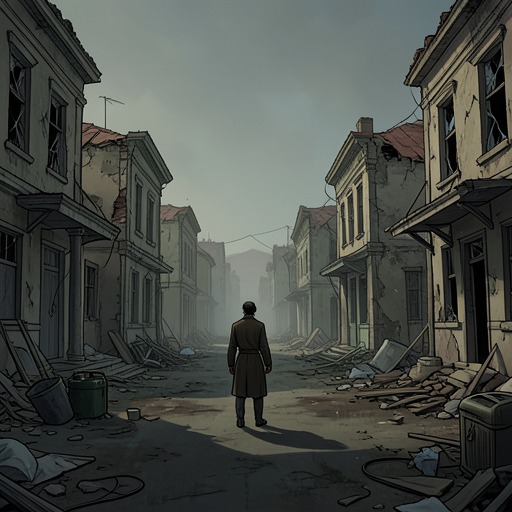
The final inventory is architectural as much as demographic. Spencer’s Sundries and Pharmacy closes in January, followed into abandonment by Crossen’s Agricultural Store, the hardware store, Barlow and Straker’s Furniture Shop, the Excellent Café, and the Municipal Building. The grammar school and the tri-town consolidated high school are empty; their books and furnishings have been transferred to makeshift facilities in Cumberland, and no children from Jerusalem’s Lot are expected to attend when the new school year begins. The town is reduced to abandoned shops, deserted houses, overgrown lawns, empty streets, and back roads. A population has not simply declined. Its institutions have been stripped of their users, leaving a civic shell that records absence everywhere.
Rumor, Silence, and Local Memory
Once the population begins to vanish, neighboring communities convert uncertainty into legend. Jerusalem’s Lot is reputed to be haunted. Colored lights are said to hover over the Central Maine Power lines, and some people entertain the possibility of UFO abductions. Others speak of a “dark coven” practicing black mass and imagine that divine wrath has fallen upon the town named for the Holy Land’s holiest city. Less supernatural observers compare the pattern to young men who disappeared near Houston and were later found in mass graves. These theories differ in content, but all acknowledge that ordinary explanations no longer contain the scale of the event.
The most disturbing feature of the recovered residents is not merely that they left, but that they will not discuss Jerusalem’s Lot. Parkins Gillespie says only, “I just decided to leave.” Charles James attributes his departure to the failure of his business. Pauline Dickens does not answer the reporter’s letter, and Rhoda Curless refuses to speak about the town at all. Their reticence creates a second disappearance: even when bodies or addresses can be located, testimony remains missing. The community’s history cannot be reconstructed through its former inhabitants because they either cannot or will not provide an account.
This silence belongs to a longer tradition of suppressed local violence. The scandal surrounding the Marsten House occurred before the living generation was born, yet Jerusalem’s Lot preserves it through ceremonies of recollection, passing its horrors from generation to generation. The town knows that Hubert Marsten killed Birdie Marsten, but it does not know what preceded the murder or why Birdie begged him to do it. It knows that Albie Crane killed his wife and hid her in an old well, but the fuller truth survives only outside the town’s ordinary knowledge. The current disappearances thus repeat an established pattern: violence becomes rumor, rumor becomes inherited memory, and crucial facts remain concealed beneath familiar stories.
A History of Recurrence
Jerusalem’s Lot had been incorporated in 1765, though the settlement itself was founded earlier by a splinter group of the Puritan faith headed by James Boon. Later records preserve another catastrophe: Robert Boone’s coded diary dates the 1789 episode from June 1 to October 27, ending four days before the cataclysmic disappearance described by Mrs Cloris. The diary links Great-uncle Philip, the town, and the book in the desecrated church, while also presenting the settlement as a religiously distorted community shaped by fanaticism, exorcism, incest, and occult belief. The modern disappearance therefore enters a place whose history already contains a precedent for collective vanishing.
The Marsten House adds a more immediate historical layer. Hubert and Birdie Marsten lived there for eleven years after retiring to Jerusalem’s Lot in 1928, and four children disappeared between 1928 and 1939. None was ever found. Their disappearances could be treated individually as rural accidents, but the complete absence of remains and their connection with the house give them retrospective significance. When the residents of the town begin to disappear in the 1970s, the earlier child disappearances become part of a recurring chronology rather than an isolated series of misfortunes.
The town’s physical organization intensifies this sense of recurrence. Brock Street and Jointner Avenue cross at right angles, giving the municipality the appearance of a telescopic sight; the wooded northwest quadrant rises toward the Marsten House, while the southeast contains farms and Schoolyard Hill, and the southwest Bend is crowded with trailers, junked cars, children, bars, and improvised domestic spaces. This map makes disappearance spatially legible. Roads, schools, shops, cemeteries, and houses form a network of ordinary observation, but the network cannot turn presence into knowledge. A town that knows everyone’s business still fails to know where its people have gone.
Consequences and Significance
The immediate consequence is abandonment. There are no children, no open businesses, and no functioning public center. Even people who remain awake during the crisis do not know the truth; some vaguely suspect that something is wrong, but they instinctively turn on every light, search drawers and attic boxes for religious symbols, move cautiously through their houses, and refuse to look out the windows. The response is collective without being informed. The town’s inhabitants behave as if their bodies remember a danger their minds cannot articulate.
The disappearances also transform time. Jerusalem’s Lot had imagined itself exempt from the country’s wars, accidents, and political crises, receiving national torment as distant television knowledge. “Nothing too nasty could happen in such a nice little town.” The disappearance destroys that local insulation. History, which had seemed to pass elsewhere, arrives as an intimate force that empties houses and closes schools. The ordinary schedule of rural life gives way to a silence in which the town appears to have anticipated the evil’s arrival.
Finally, the empty town becomes the durable image through which the catastrophe survives. The newspaper calls it a ghost town, but the phrase is more than journalistic sensationalism: it identifies a community whose former residents have become both absent persons and suppressed witnesses. Later explanations connect the modern vanishing to the vampire outbreak and to the older supernatural history of Jerusalem’s Lot, while the official record remains divided between relocations, missing-person traces, rumor, and silence. The disappearance is therefore not a single moment but a process of social erasure, one that leaves behind a mapped, remembered, and haunted place where the absence of people is itself the clearest surviving fact.